Skip to content

Every Himalayan salt lamp bulb is a small incandescent heat source first and a light source second. That distinction decides which replacement part a retailer stocks, which SKU an electrician signs off for a 230V market, and how many “my lamp stopped glowing” tickets a distribution centre absorbs in a season. The guide below sets out the bulb types that work, the wattage tiers we ship against lamp weight, the base and voltage variants a wholesale programme has to order separately, and the moisture behaviour that kills more salt lamp bulbs than the filament does.

- Salt lamps need a filament bulb that runs warm: 10-40 watts depending on stone weight, with 15 watts the default for the 3-11 lb range.
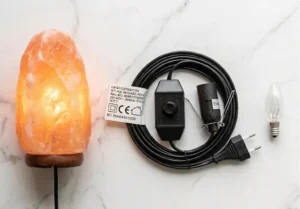
- A Himalayan salt lamp bulb is a small clear or amber incandescent on a candelabra-sized base; the same shell in an LED version gives light without heat.
- Heat is the functional requirement, not a by-product: a warm stone stays dry, a cold one weeps moisture and corrodes the socket.
- Voltage and bulb base differ by market, so a 110-120V North American SKU and a 220-240V European SKU are two separate line items, not one SKU with a different label.
- Our lamp electrical sets are tested to CE, RoHS and UKCA requirements; the bulb is the one consumable a retailer can restock without a factory order.
- Replacement bulbs are ordered in packs against the lamp count, normally one spare per unit plus a shelf reserve, because a cracked bulb is the most common damage claim on a salt lamp.
Why the Bulb Inside a Himalayan Salt Lamp Is a Heat Source
A salt lamp is a hollowed piece of pink Himalayan salt with a bulb sitting inside the cavity. Salt is hygroscopic: it pulls water out of the air and holds it on the surface. With the lamp switched off in a humid room, that moisture collects as beads and slowly runs down the stone, pooling at the base and creeping into the socket where the bulb shell contacts the terminals. A warm filament drives that moisture back off the surface, which is why a lamp that stays on for long periods looks dry and a lamp that is switched on for ten minutes a night ends up damp and corroded.
This is also the honest answer to the wellness copy most salt lamps were sold with. Claims that a lamp bulb’s heat releases negative ions that purify a room are not something we can document, and a buying desk should not have to defend them to a retailer’s compliance team. What the heat does is keep the stone dry, keep the socket clean and keep the light steady, and those three effects are visible on the shelf. For the decorative side of the category, the rock salt lamp benefits page covers how the glow is specified, and for the comparison that decides whether a salt product is lighting or kitchenware, the salt lamp vs cooking block breakdown covers the food-contact side.
Bulb Types Compared: Incandescent, Halogen, Fluorescent, LED
Four bulb families get specified into salt lamps and only two of them belong there.
| Bulb type | Heat output | Verdict for a salt lamp |
|---|---|---|
| Incandescent (T-shape, clear or amber) | Warm, steady, sized to the cavity | Standard fit. The amber glass also deepens the pink of the stone, which is why it photographs well on a listing. |
| Tungsten filament | Same behaviour as incandescent | Acceptable. The terms describe the same construction and are used interchangeably on packing lists. |
| Halogen | Considerably hotter than the cavity is designed for | Do not specify. Excess heat dries the stone unevenly and stresses the socket and cord insulation. |
| Fluorescent / CFL | Low, and the tube will not fit the cavity | Not applicable to this product form. |
| LED | Cool to the touch | Wrong part for a traditional lamp because the stone stays damp, but correct by design in the 5V USB salt lamp line, where the product is a night light rather than a warming stone. |

When a buyer asks for an LED version of a classic hollowed lamp, the failure usually shows up in week three: the stone sweats, the salt film creeps down to the base, and the socket corrodes because nothing is evaporating the moisture. If the goal is energy saving rather than a warm stone, the right answer is a low-wattage incandescent on a timer or the USB product, not an LED bulb retrofitted into a lamp that was engineered around filament heat.
Wattage by Lamp Weight
Wattage is matched to the mass of stone, because a bigger slab takes more heat to stay dry. This is the tier table we ship against, and it is what goes on the packing list next to the lamp count.
| Lamp weight | Bulb wattage | Where it lands in a catalogue |
|---|---|---|
| 3-11 lb | 15 W | Night light and desk sizes; the volume tier for gifting programmes. |
| 12-20 lb | 25 W | Standard home-lamp size, the default shelf SKU in most markets. |
| 21-40 lb | 40 W | Large single-stone lamps; check the socket rating before upping wattage. |
| 41-200 lb | 50-60 W | Statement pieces and floor lamps, usually built with a hi-hat socket. |

Two rules keep this table honest in the field. Do not exceed the socket rating to make a dim lamp brighter; the fix is a bigger stone or a lighter shade, not more watts. And do not drop a 15 W bulb into a 30 lb lamp because it is cheaper, because the stone will never reach the temperature that keeps it dry, which turns a small saving into a warranty problem.
Bulb Base, Voltage and the SKU You Actually Order
Salt lamp bulbs use the small candelabra-sized bases familiar from night lights rather than the standard lamp shell, and the exact base plus the mains voltage travel together as market-specific configurations. A programme selling into North America orders the 110-120V build; a programme selling into the EU or UK orders the 220-240V build with the matching plug, cord and bulb. These are two separate line items in the order, not one SKU with a different sticker, and mixing them is a common cause of a container arriving with lamps that cannot be switched on legally in the destination market.
Cord, switch and plug complete the set. Our lamp electricals are specified and tested against CE, RoHS and UKCA requirements, and the compliance picture for putting marked electrical goods on the British market is summarised on the official UKCA and CE product guidance at gov.uk, which is worth handing to a retailer’s buyer when they ask what paperwork sits behind the marking. Sockets, cords and bulb shells are also the parts a shop can restock without a factory order, which is why the salt lamp accessories line exists as its own catalogue section.
Size drives the carton, the carton drives the freight quote, and the weight band drives the bulb. For the dimensional side of that chain, the salt lamp size chart gives the diameter and weight ranges by style so a buying desk can line up its wattage tier and its carton count from the same sheet.
Why Moisture, Not the Filament, Kills Salt Lamp Bulbs
The failure a distributor actually sees is rarely a burned-out wire. It is a damp stone: condensation forms inside the cavity, runs to the socket, and corrodes the contact until the lamp flickers or dies with a good bulb still in it. Three conditions cause most of it.
- Short duty cycles. A lamp switched on for a few minutes a night never dries out, so the moisture stays where it can reach the terminals.
- Storage in the carton. Sealed in a damp warehouse a lamp will sweat into its own packaging, which is why cartons ship with moisture protection and why retail stock should be opened at destination rather than held closed for months.
- Humid rooms. Bathrooms, coastal showrooms and unheated stores in wet seasons are the three settings where bulb and socket complaints cluster.
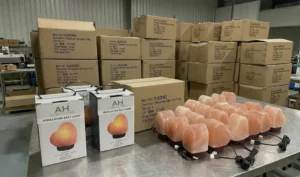
Packaging is where a wholesale programme can buy its way out of this. Each lamp is wrapped, packed six to twelve to a three-ply inner, and then into a five-ply BC-flute export carton that has to pass ISTA 3A drop testing, with gross weight held between 8 and 15 kg so the carton survives a pallet cycle rather than splitting on the third one. Verifying the lamp itself on arrival is the other half of the job: how to confirm a salt lamp is authentic covers the stone tests a receiving team can run without instruments.
Changing a Salt Lamp Bulb Safely
End-user instructions belong in the retail box, because a bulb change done cold and carelessly is how a customer cracks both the glass and the stone. The sequence we print is short: unplug the lamp, let the shell cool, remove the base plate or the stone from its stand, take the old bulb by twisting rather than pulling, seat the replacement without overtightening, and dry any salt film from the cavity before reassembly. A customer who follows it gets years out of one bulb; one who changes a hot bulb with the lamp still energised gets a burned hand and a hairline crack in the shell.

Keep a spare in the drawer is the right advice for retail, and for a wholesale programme it is a margin line: a bulb is a low-cost, high-frequency replacement, so it sells well as an add-on at checkout and as shelf stock near the lamps. That is the reason we quote replacement bulbs against the lamp count on the same order sheet rather than as a separate programme.
Stock the Bulb Beside the Lamp
Lamps, replacement bulbs and cord sets are quoted on one order sheet, with trial orders from 100 pieces and a USD 500 minimum order value shipped by air on DDP terms.
Himalayan Salt Lamp Bulb: Frequently Asked Questions
What bulb goes in a Himalayan salt lamp?
A small incandescent night-light bulb in the same base and wattage the lamp shipped with: 15 W for a 3-11 lb stone, 25 W for 12-20 lb, 40 W for 21-40 lb. Clear glass reads warm; amber glass deepens the pink of the stone.
Can I use an LED bulb instead?
Not in a lamp engineered around filament heat. An LED runs cool, so the stone stays damp and the socket corrodes. LED is the correct light source for the 5V USB night-light line, which is a different product.
Why does my bulb keep burning out?
Most repeat failures are moisture, not the bulb. Condensation inside the cavity reaches the socket and eats the contact. Longer duty cycles, dry storage and a moisture-wiped cavity fix it more often than a higher-rated bulb.
Can I fit a higher wattage to make the lamp brighter?
No. Socket and cord are rated for the spec they shipped with, and exceeding it heats the insulation and the stone unevenly. Move to a larger stone or a lower-wattage shade instead.
Do replacement bulbs need their own compliance marking?
In our build the lamp set, cord and plug carry the CE, RoHS and UKCA documentation for the destination market. Bulbs are ordered per market voltage, so 110-120V and 220-240V are separate line items on the order.
Ordering Notes
Trial orders start at 100 pieces against a USD 500 minimum order value and normally move by air express on delivered-duty-paid terms, which is the fastest way to put a lamp and its bulb spec in front of a buyer. Wholesale and custom programmes start at 300 pieces against a USD 3,000 minimum order value with full catalogue access and OEM work; custom colour boxes are a 500-piece line. Production for those runs is 60-90 days to port, and the lamp SKU and its bulb tier should be agreed before that clock starts, because a wattage change after the cartons are printed is a re-print, not a note on the invoice. Send the size range and destination market to our sales desk and we will return the lamp, bulb and carton count as one sheet.